





This is for the architect, interior designer, builder / general contractor, or consultant who knows the first half of the year gave them information, but hasn’t yet turned that information into decisions.
It may feel like yesterday but six months ago, you sat down with a blank year ahead of you and set goals and made decisions about what this year was going to look like.
Now you have something January-you didn’t have: data.
Six months of hard data about what’s working in your firm, what isn’t, where your clients are coming from, where your time is actually going, and what the gap looks like between what you planned and what has actually happened. That’s not a report card. That’s a map — and a map is infinitely more useful than a hope.
Here’s what I want you to know before you read further: if your year hasn’t gone the way you hoped, this is not the moment to spiral. This is the moment to get specific. You have six months of runway ahead of you. The firms that finish the year strong aren’t necessarily the ones who had a perfect first half. They’re the ones who got honest at the midpoint, adjusted their strategy, and walked into the second half with a plan instead of a prayer.
Let’s look at what you’ve actually got.
Why a Mid-Year Business Review Matters More Than Your December Recap
A mid-year business review for AEC firms matters because it gives you time to change the outcome — a December review only tells you what happened.
Most firm owners do some version of an annual review. Far fewer do a genuine mid-year check-in, and that’s the gap where a significant amount of business momentum is lost or continues in the wrong direction.
There’s also something psychologically distinct about the six-month mark. At the end of Q1, you’re close enough to January to convince yourself things will sort themselves out. At the end of Q2, you have enough data to know whether they actually have. The patterns are visible now. The gaps that were “just a slow start” in March have had time to either resolve or entrench.
That clarity is a gift even when it’s uncomfortable. I’d argue especially when it’s uncomfortable.
A goal you can still act on is an opportunity. A goal you ignore until December is just a regret.
The 5-Area Halftime Assessment Framework for AEC Firms
A halftime business assessment for AEC firms covers five areas: revenue and financial health, business development and pipeline, operations and systems, client experience and relationships, and owner capacity and sustainability.
At Ratio Solutions Group, I work with boutique AEC firm owners to move from vague concern to specific second-half decisions — and this is the five-area framework I use to do it.
Set aside 30 to 45 minutes. Get your goals in front of you – wherever you wrote them, or whatever you can reconstruct. No judgment if January’s plans are living in a notebook you haven’t opened since February. Reconstruct what you can and work with what you have!
Work through each area honestly – even when what you discover may not be pleasant.
Area 1: Revenue and Financial Health
To assess revenue health at the midpoint, compare year-to-date revenue against your annual target, review project margins for scope creep, and identify any unbilled work before the quarter closes.
Start here, because the numbers ground everything else. They don’t have opinions about how hard you’ve been working, and they don’t care about your intentions. They just tell you where you are.
Ask yourself:
Where does your revenue stand at the halfway point compared to where you planned to be? If you had an annual revenue goal, you’re looking for roughly 50% of it in the books — though project-based firms often have legitimate reasons for back-half weighting, so context matters.
Are your project margins tracking close to your estimates? Scope creep, over-delivery, and underpriced change orders are the three most common margin killers in boutique AEC firms. Six months is usually long enough to see a pattern if one exists.
Is there unbilled work sitting somewhere — in your inbox, on a spreadsheet, in your head — that should already be invoiced? Unbilled work is one of the most common and most fixable cash flow problems in small firms. It is not a revenue problem. It is an invoicing problem, and it has a specific solution.
If you are behind on revenue, the question that matters is not why you didn’t work harder. The question is: is this a sales problem, a pricing problem, or an operations problem? They look similar from the outside and require completely different solutions. Getting the diagnosis right is the whole game.
Area 2: Business Development and Pipeline
A healthy mid-year pipeline for an AEC firm includes active lead conversations, proposals out, and warm referral relationships — not just past clients and hope.
Revenue goals without business development activity are just wishes. This area is about whether you’ve been doing the work that fills the pipeline — not just when things got slow and you panicked, but consistently.
How many new leads have come in over the first half of the year? Do you know where they came from? If you can’t answer that second question, that’s important information. You cannot replicate what you cannot track.
What does your current pipeline look like heading into Q3? Is it healthy — a realistic mix of conversations, proposals out, and warm relationships that could convert? Or is it thin in a way that should be concerning you right now, while there’s still time to do something about it?
Here’s the pattern I see most often in my work with AEC firms: the firm that’s scrambling for work in October is usually the firm that stopped doing business development in May. The lag is real. The pipeline you are building right now is the revenue you will be closing in Q4.
If business development has been inconsistent, the second-half fix is simple to name and genuinely hard to do: make it non-negotiable. Time-blocked, recurring, protected from project work regardless of how full the calendar looks.
Area 3: Operations and Systems
The most common operational gap in small AEC firms at midyear is processes that are still undocumented – living in the owner’s head rather than in a system anyone else could follow.
This is the area most firm owners rate optimistically and should probably rate more honestly. Operational problems are easy to defer because they don’t create a crisis today — they create a hundred small inefficiencies that quietly drain your time, your margin, and your sanity over months.
Six months in, you have enough evidence to know whether the operational improvements you planned in January have actually happened.
Which operational goals did you set for the year? How many have you made meaningful progress on — not started, not almost finished, but actually implemented and running?
What processes are still living entirely in your head, or your team’s head, that were supposed to be documented by now? Every undocumented process is a bottleneck waiting to happen — and a key-person dependency you’re carrying without realizing it.
What is the one operational problem you have been tolerating since January that is still exactly as it was six months ago? Name it. Write it down. It costs you something every week it stays unnamed and unaddressed, even if you can’t always feel the cost directly.
The second half of the year is a good time to pick one operational thing — one — and actually fix it. Not overhaul everything. One real fix, implemented and running by September, is worth more than five things that are perpetually “in progress.”
Area 4: Client Experience and Relationships
Client experience at midyear is a direct predictor of referral pipeline in Q3 and Q4 — how your current clients feel right now will determine how many introductions you receive in the second half of the year.
This is not a soft metric. This is pipeline strategy, and it is one of the most underutilized levers in small AEC firms.
Are your current clients genuinely well-served? Not just “fine.” Not just “no complaints.” But actually looked after in a way that makes them want to send people your way?
Have you collected testimonials from projects that wrapped up in Q1 and Q2? If those windows haven’t closed yet, they are closing. A client who loved working with you six months ago is warmer than one from a year ago, and the ask gets harder the longer you wait. Need help asking, storing and actually using your testimonials? Check out The Testimonial Toolkit in the shop here.
Are there any client relationships that need attention before Q3 starts? A check-in that hasn’t happened? A concern that was mentioned and not followed up on? A project that wrapped without a real close?
Your current clients are your best business development asset. The second half of the year is a good time to treat them like it if you haven’t been previously!
Area 5: Your Own Capacity and Sustainability
Owner capacity is a legitimate business metric — a firm that runs on the owner’s heroics is operationally fragile, and six months is long enough to know whether the current pace is sustainable.
This area gets left off most business assessment frameworks, which is exactly why it belongs on this one! I’ve worked with enough AEC firm owners to know that the business that looks fine on paper is sometimes being held together by someone running well past empty.
Are you operating at a pace you can actually maintain through a full second half? Not the pace you think you should be able to maintain. The pace that is actually true for you, in your life, with your capacity.
What tasks are you still doing that should be delegated, documented, or systematized out of your personal responsibility? If the answer is “a lot,” that is your single highest-leverage operational opportunity for the second half.
What would need to change for Q3 and Q4 to feel meaningfully better than the first half? Get specific. Vague answers produce vague outcomes.
What to Do With What You Find
After completing a mid-year business review, AEC firm owners should identify their top two wins, name their single biggest gap, make one decision per area, and schedule their Q3 check-in before closing the assessment.
The assessment is only valuable if it produces decisions. Not a new plan. Not a revised goal spreadsheet. Decisions — specific, made now, and firmly committed to.
Name your top two wins from the first half. What actually worked? Name it specifically, because wins have a way of getting taken for granted. If something worked in the first half, make sure it is protected in the second half — don’t accidentally deprioritize the thing that is actually carrying you.
Name your single biggest gap. Not a list of everything that needs work. The one thing — the gap that, if closed, would have the most positive ripple effect on everything else. One thing. Write it down. That is your Q3 priority.
Make one decision per area. Keep doing this. Stop doing that. Start doing this. Adjust this target. One decision per area, made now, is worth more than a detailed second-half plan made in September when the window is smaller and the pressure is higher.
Schedule your Q3 check-in now. Before you close this tab. August, roughly two months into Q3. (I’ll share an updated Q3 Workbook too!) Same framework. Same 45 minutes. The firms that grow consistently are the ones that check in consistently — not just when something goes wrong, but as a deliberate, recurring practice.
The Second Half Is Longer Than You Think
Six months of runway is a significant amount of time. Pipelines have been rebuilt in six months. Systems have been overhauled. Relationships have been repaired. Goals that looked completely out of reach in June have been reached by December — not through heroics or desperation, but through clear-eyed decisions made at the right moment.
This is the right moment.
You now know things that January-you didn’t know. What your clients actually respond to. Which business development activities are producing leads and which ones are producing the feeling of busy-ness without the results. You know where your operations are holding you and where they’re helping you. You know, honestly, what this year has cost you in terms of your own capacity — and what you want the second half to cost instead.
Use what you know. That is the whole advantage of getting to halftime.
The second half of the year belongs to the firms that show up for it with a plan.
Ready to Work Through Your Assessment?
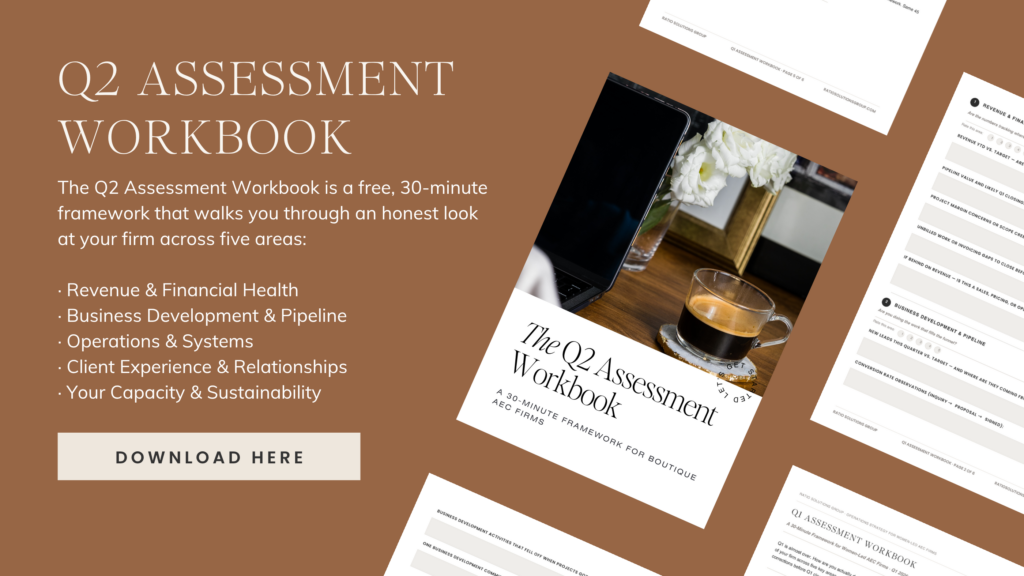
Download the free Q2 Assessment Workbook — all five areas, guided prompts, and a course-correction planning section so you walk away with decisions, not just a diagnosis.
Book a 90-Minute Strategy Session — bring your halftime assessment and let’s build your second-half plan together.
Did the first half surface a systems problem? This post on five signs your business systems are holding you back is a good next read.
Want to see how this framework applies to Q1? Start here — same five areas, different moment in the year.
Frequently Asked Questions
What is a mid-year business review for AEC firms? A mid-year business review for AEC firms is a structured assessment conducted at the end of Q2 that evaluates firm performance across five areas: revenue and financial health, business development and pipeline, operations and systems, client experience and relationships, and owner capacity. The goal is to identify what’s working, name what isn’t, and make deliberate decisions for the second half of the year while there is still time to act on them.
How long does a mid-year business review take? A thorough mid-year review for a small AEC firm takes 30 to 45 minutes when completed using a structured framework. This is most effective as a single focused session rather than spread across multiple days, so you can see the full picture at once and move directly into decision-making.
What should an AEC firm owner do if revenue is behind at midyear? If revenue is behind at the midyear point, the first step is diagnosing whether it is a sales problem, a pricing problem, or an operations problem — because each requires a different response. Common midyear revenue gaps in small AEC firms include unbilled work that hasn’t been invoiced, proposals that weren’t followed up on, and scope creep that eroded project margins without being addressed through change orders.
Why do boutique AEC firms skip quarterly business reviews? Most boutique AEC firm owners skip quarterly business reviews because project work crowds out business development and operational tasks when capacity is tight. The irony is that skipping the review makes capacity problems worse over time — undocumented processes, weak pipelines, and unaddressed client concerns compound quietly until they become crises.
When should an AEC firm schedule its Q3 business review? An AEC firm should schedule its Q3 business review for August, approximately two months into the quarter. This gives enough time for Q3 patterns to be visible while leaving enough runway to course-correct before Q3 closes. Scheduling it at the end of the Q2 review — before closing the workbook — dramatically increases the likelihood it actually happens.
What is the difference between a Q2 review and a mid-year review for AEC firms? A Q2 review and a mid-year review cover the same time period but serve different purposes. A Q2 review closes out a single quarter. A mid-year review uses Q2 as the lens through which to assess the entire first half of the year — which makes the questions bigger, the patterns more visible, and the decisions more consequential. The mid-year frame is more useful because it gives you the full context of what you planned in January versus what actually happened.


+ show Comments
- Hide Comments
add a comment